
What It Takes to Launch a Digital Health Program
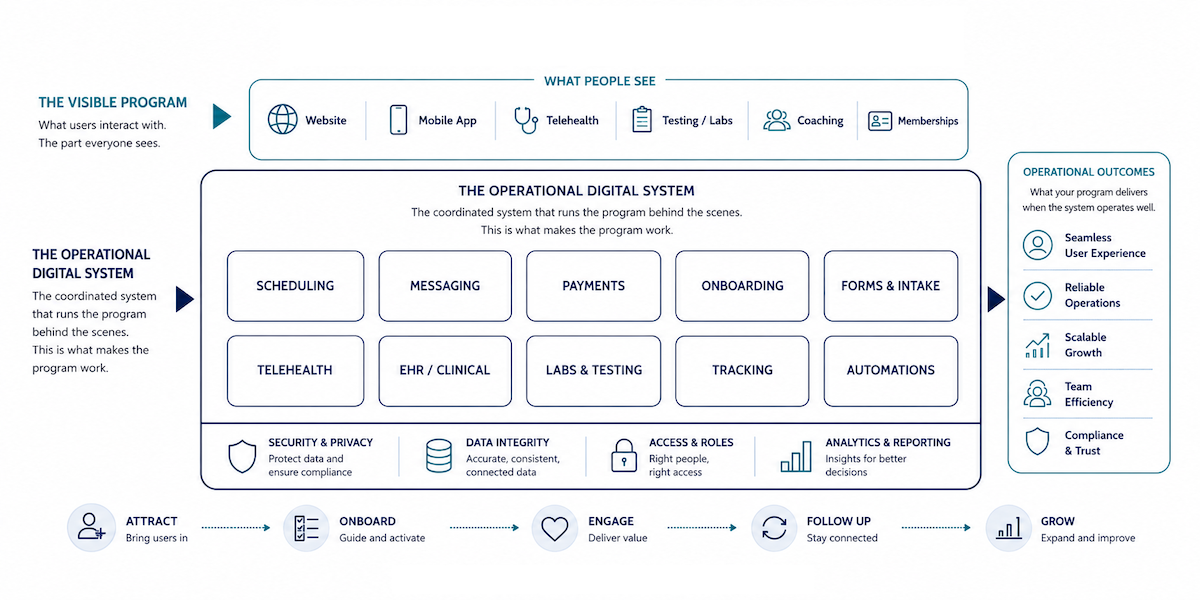
You have identified a need and defined a program that offers a responsive solution. The business concept itself feels straightforward. The less familiar part is often the operational digital system. Most people start with the visible part of the idea: a website, a mobile app, a product, a service (e.g., telehealth, testing, coaching, membership, and alike).
What is usually less visible at the beginning is the operational digital system required underneath the program. Once users begin entering the program, the business must coordinate a growing set of operational activities:
- onboarding
- scheduling
- forms
- messaging
- payments
- consultations
- labs or testing
- follow-ups
- tracking
- reminders
- ongoing engagement
- reporting
This is where many digital health founders and clinics expanding online discover they are not simply launching a website or service. They are building an operational digital system. Even relatively simple programs often require multiple software tools working together:
- scheduling tools
- telehealth platforms
- payment systems
- messaging platforms
- forms and intake systems
- EHRs
- tracking applications
- analytics tools
- automation software
A typical early program may use Calendly for scheduling, Zoom for telehealth, Stripe for payments, messaging tools for reminders, and one or more systems for onboarding and tracking. Initially, this approach often feels manageable. Most tools are easy to start with. Many are inexpensive at small scale.
No-code and automation tools emerged because they solve a real problem. Many do not want to hire engineers or build custom software simply to launch a digital program. These tools make it possible to create web and mobile applications, and connect scheduling, messaging, forms, payments, onboarding, and other workflows quickly without writing code. This is one reason digital programs can launch much faster today than even a few years ago.
For early-stage programs, no-code tools and workflow automations can work surprisingly well. A scheduling event can trigger a confirmation message. A completed form can notify staff. A payment can unlock onboarding steps. These operational shortcuts reduce manual work and help small teams move quickly. But these tools are usually designed to automate individual tasks or connect isolated workflows. They are not designed to govern the full operational lifecycle of a growing digital program.
You can often assemble a functioning digital program surprisingly quickly. This creates the impression that the operational side of the business is largely solved. But operational complexity usually begins appearing underneath the surface almost immediately. Consider a relatively simple user journey:
- A user enters the website
- They schedule a consultation
- A confirmation message must be sent
- Forms must be completed
- Payment must process correctly
- The consultation must occur
- Testing may need to be ordered
- Results may need review
- Follow-up steps may need triggering
Every step depends on another step happening correctly. This is where operational coordination becomes increasingly important. Questions begin appearing that are not visible during early planning:
- What happens if onboarding is incomplete?
- What happens if scheduling changes?
- What happens if a message fails?
- What happens if a user misses a consultation?
- What happens if testing results are delayed?
- What happens when workflows change?
- What happens when the business grows from 20 users to 2,000?
The challenge is not usually a lack of tools. The challenge is coordinating operations across them reliably. This distinction becomes more important as programs grow.
In early stages, teams often compensate manually. Someone sends a message. Someone checks whether forms were completed. Someone verifies follow-ups. Someone reconnects broken workflows. At small scale, these manual interventions may appear manageable. As operational complexity grows, however, manual coordination becomes increasingly difficult to sustain. Programs often begin experiencing:
- fragmented workflows
- operational gaps
- inconsistent user journeys
- brittle automations
- duplicate processes
- hidden manual labor
- increasing software maintenance
- rebuilding pressure as complexity grows
Understanding this early changes how digital programs should be built.
Turning your idea into a running program should not require building, stitching, or maintaining software infrastructure. That is where operational complexity, delays, and cost compound. Imagine if every person had to write an operating system for their computer before installing and running applications.
To this end, we built Stratoum as an operating system for digital health and wellness programs. It enables organizations to go from an idea to a running program in days, because they do not have to build and maintain custom software infrastructure. Like an orchestra conductor coordinating many instruments, Stratoum coordinates users, services, workflows, and data across the program so every step happens in sequence, automatically, without gaps or manual intervention. At the same time, PHI remains inside their tools while Stratoum governs operations as one coordinated system.
With Stratoum, organizations can launch fast and operate reliably as complexity grows, while using the tools they prefer and keeping their PHI entirely within their tools.