Why Automation Does Not Create Operational Coordination
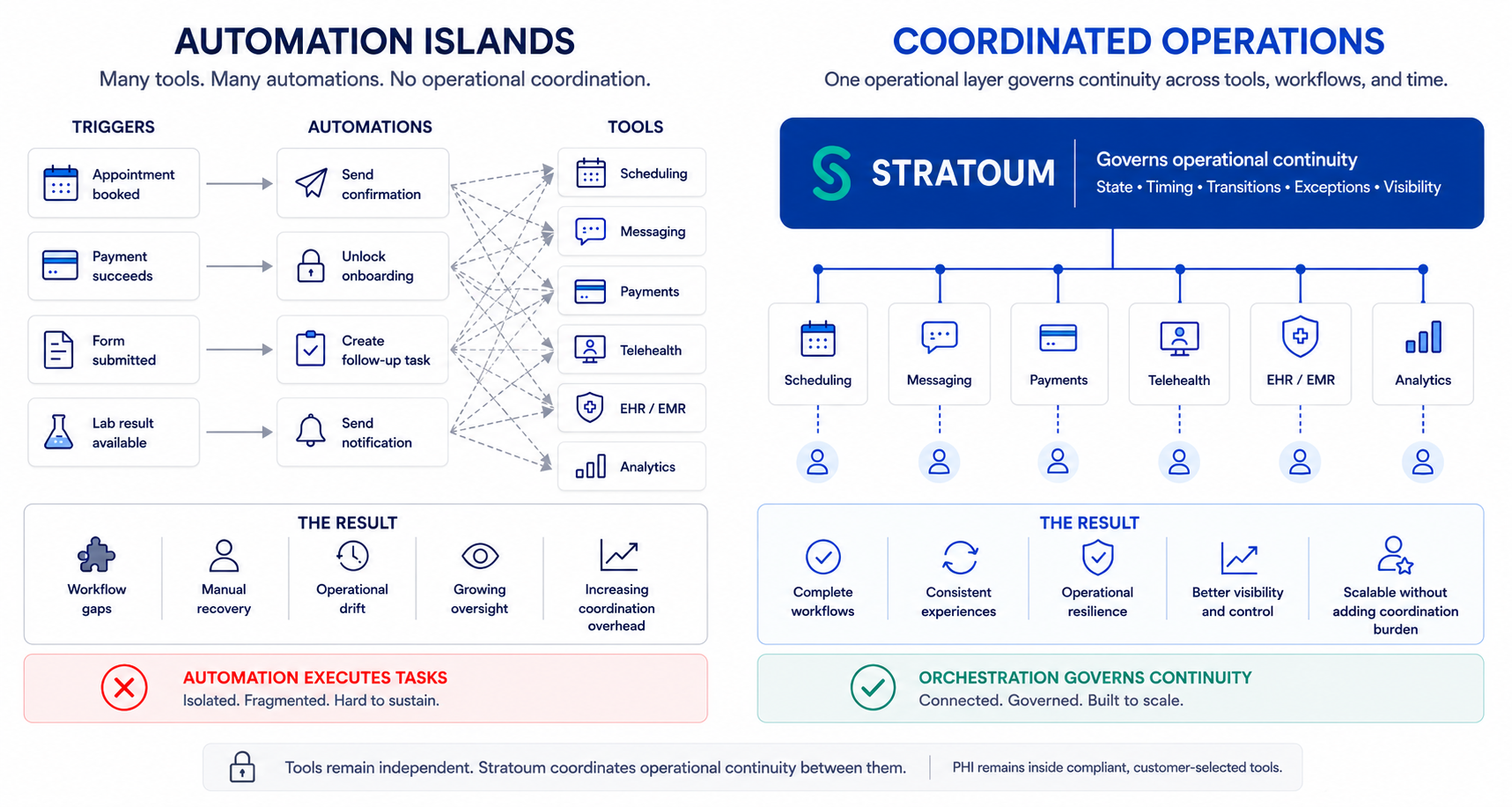
Many digital health and wellness programs eventually accumulate a growing layer of automations underneath the business. A scheduling event triggers a confirmation message. A completed form creates a task. A payment unlocks onboarding. A lab result triggers a follow-up notification.
At first, these automations appear highly effective. They reduce manual work, accelerate workflows, and help organizations operate quickly without large engineering teams. This is one reason modern digital health programs can launch much faster today than even a few years ago.
As programs grow, however, many organizations discover an important distinction: Automation does not automatically create operational coordination. This distinction becomes increasingly important as workflows, services, communications, users, and operational dependencies expand over time.
Most automation tools are designed to execute isolated trigger-action events:
- if a form is completed, send a message
- if a payment succeeds, unlock onboarding
- if a user books a consultation, notify staff
These workflows can work very well individually. The problem is that digital health programs rarely operate as isolated events. They operate as longitudinal operational environments involving:
- users
- communications
- services
- tracking
- partner systems
- operational states
- follow-up workflows
- exception handling
- timing dependencies
- ongoing engagement
This is where operational coordination becomes fundamentally different from automation.
Automation executes local actions. Operational coordination governs how the entire program continues operating reliably across workflows, tools, users, communications, and time. This distinction is often partially hidden during early growth stages because teams compensate manually when operational gaps appear. Someone checks whether onboarding completed correctly. Someone follows up when a workflow fails. Someone reconnects broken automations. Someone verifies the right message was sent at the right time.
At small scale, these interventions may appear manageable. As operational complexity grows, however, the coordination burden compounds underneath the business. Organizations often respond by adding additional automations:
- more notifications
- more conditional logic
- more workflow branches
- more integrations
- more operational alerts
Ironically, this can increase operational fragility instead of reducing it.
AI is now accelerating automation capabilities further. Messages can be generated dynamically. Follow-up logic can adapt automatically. Operational recommendations can be personalized in real time. These capabilities are powerful. But AI-driven actions still operate within a broader operational environment that must remain coordinated across workflows, communications, users, services, timing, and operational states. Intelligent task execution is not the same as governed operational coordination.
The issue is not that automation is inherently bad. Automation solves real operational problems. The issue is that automation alone does not govern operational continuity across the full lifecycle of the program. For example, a scheduling tool may know a consultation was booked. A messaging platform may know a reminder was sent. A payment platform may know a transaction completed. A telehealth platform may know a visit occurred. But no single operational layer necessarily governs how those events relate operationally across the entire user journey.
This exposes an important architectural gap. Programs increasingly depend on coordinated execution across multiple tools, workflows, communications, and operational states. Yet many underlying operational environments remain fragmented across isolated automations and disconnected operational logic. This fragmentation often appears operationally before it appears architecturally. Teams begin experiencing:
- workflow gaps
- duplicate operational effort
- manual recovery
- growing operational oversight
- inconsistent user journeys
- automation overlap
- operational drift between tools
- increasing coordination overhead
At this point, organizations often assume they need more automation. In reality, they need a different operational model.
The deeper issue is that digital health programs increasingly behave less like isolated workflows and more like continuously operating environments requiring governed coordination across systems and time. This is where orchestration becomes fundamentally different from automation.
Automation focuses on executing tasks; orchestration focuses on governing operational continuity. The distinction matters because modern digital health programs involve far more than isolated workflow execution. They require coordination across:
- services
- communications
- partner systems
- users
- timing dependencies
- operational transitions
- longitudinal engagement
- operational visibility
- compliance boundaries
As programs scale, maintaining continuity across these environments becomes increasingly important.
Otherwise, operational coordination gradually shifts from infrastructure into human compensation through oversight, reconciliation, recovery, and manual intervention. This is one reason many digital health organizations eventually experience growing operational strain even when individual tools and automations appear to function correctly. The issue is not whether isolated tasks are automated. The issue is whether the entire operational environment is coordinated reliably as complexity grows.
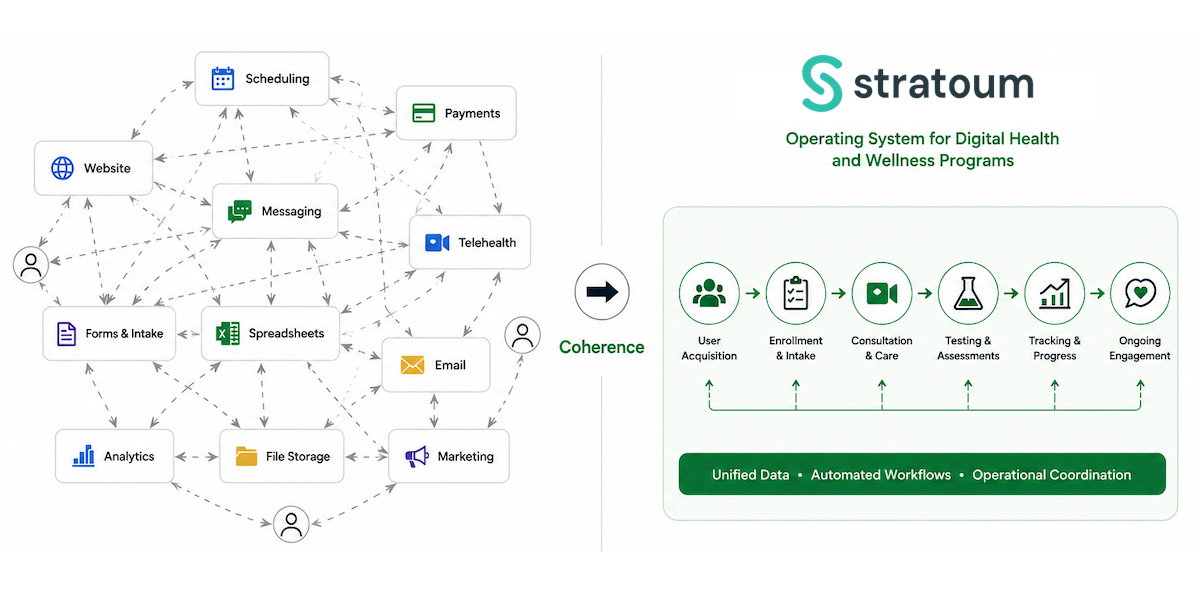
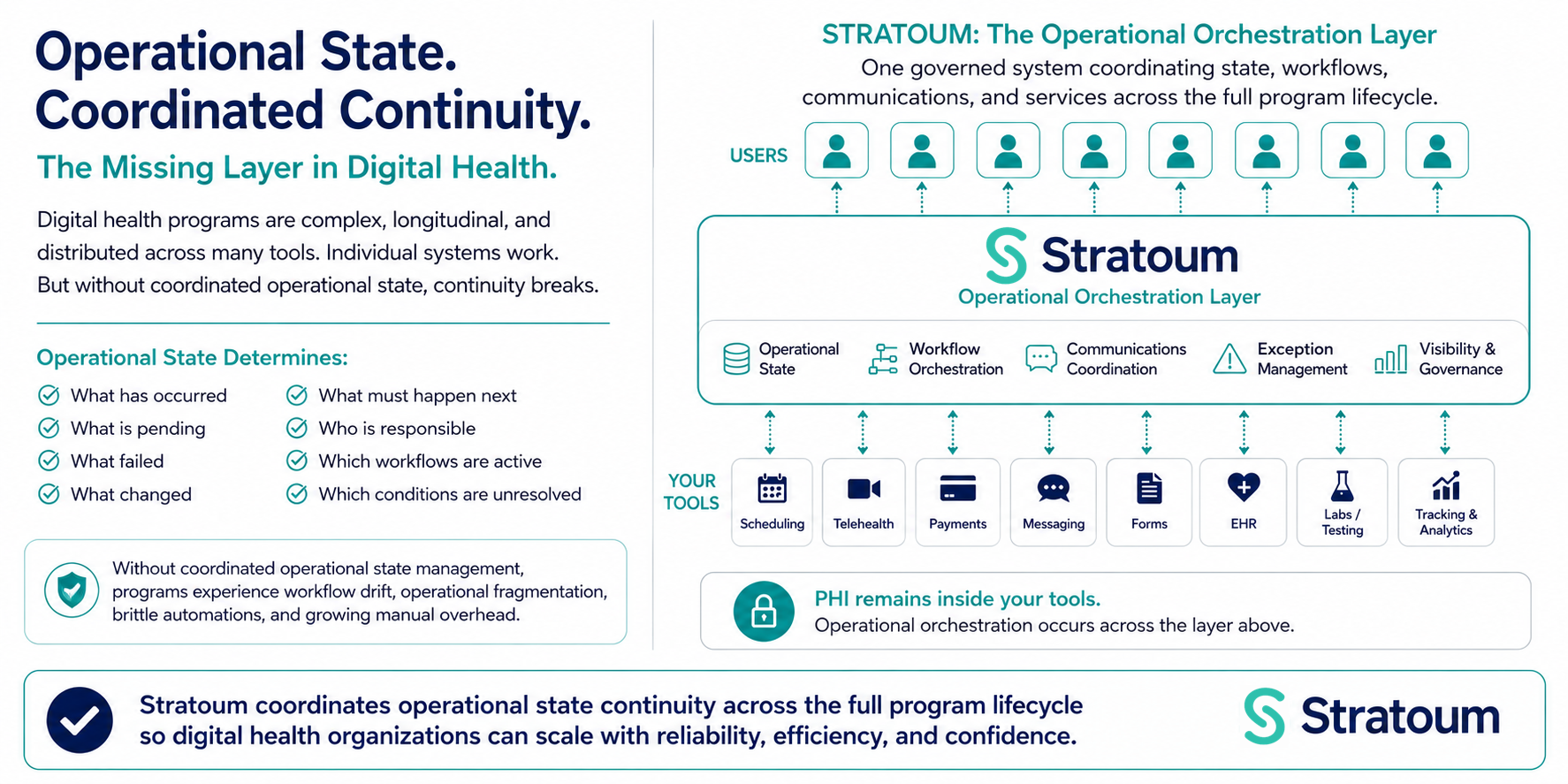
Stratoum is designed around this distinction. Instead of treating automations, workflows, communications, services, and integrations as separate operational islands, Stratoum coordinates them as one operating system governing how the program operates across tools, workflows, and time. Organizations can continue using the tools and partners they prefer or have, while Stratoum coordinates operational continuity between them. Most importantly, PHI remains inside their tools,while operational coordination occurs separately.This changes the operational model from managing automations to governing operational continuity across the entire program lifecycle.